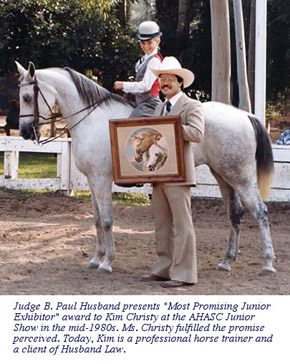
Mr. Husband was recently profiled in Arabian
Horse Times magazine.
That article follows below. © Arabian Horse Times Magazine 2003
Reprinted by permission.
B.
Paul Husband; A Friend of the Family in Equine Law
by Christy Egan
Have
you ever tried to explain a horse situation to a non-horse person? You
become laughingly aware of how often you use certain
difficult-to-define equine terms, like cribbing, colic, breaking level
or curb strap. Horse people speak a unique language, and like medical
doctors or ballet dancers, their terminology is special and often needs
more than a simple, cursory explanation. It’s a language that can make
discussions with people like insurance adjusters, firemen, policemen
and lawyers frustrating, particularly in moments of crisis. And, in
those moments of crisis, when you discover someone who speaks "horse,"
it’s an immenserelief. It’s like facing a climb up 30 flights of stairs
and suddenly finding you only have to conquer two
It’s
like facing a climb up 30 flights of stairs and suddenly finding you
only have to conquer two. It’s like having an issue develop between
your horse business and the IRS, and discovering Paul Husband. Paul
Husband has been a respected and successful California attorney for
over 25 years, concentrating on the equine and entertainment
industries. Still, for sheer time on the job, it can’t hold a candle to
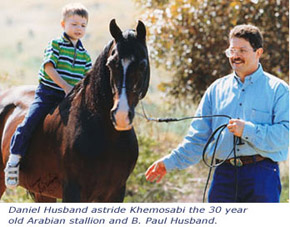
his years as a horseman. The son of well-known, California Arabian
horse breeders Bert and Ruth Husband, Paul was literally brought up on
the show circuit in the company of such Arabian horse luminaries as
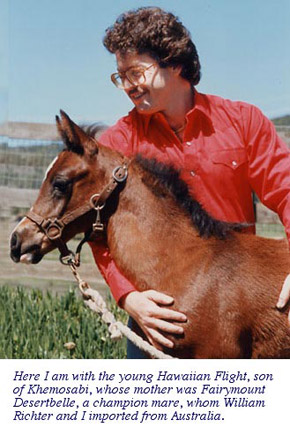
four-time National Champion Khemosabi and his dam, multi-National
Reserve Champion Jurneeka. Paul’s years as a horse lover date back to
his pre-teens. "Actually, it all began in 1960," Paul laughs, "When my
brother Bob (he was 4 at the time) asked for a pony. The pony arrived
at our house in the form of a Pinto-Shetland for Christmas. From there
we graduated up to a half-Quarter Horse and Half-Welsh horse and then
at last, to an inbred *Raffles gelding name an inbred Raffles gelding
named Nafrap, that my dad purchased for $550.00."
All
of these horse purchases ultimately led to a relationship with noted
Arabian horse trainer Jeff Wonnell. It was Jeff who showed Jurneeka at
the 1963 Scottsdale Show and then offered her to Burt and Ruth Husband
for the heart-stopping sum of $10,000
.
"My mother was shocked, I think." Paul recollects, "But my father had
taken one look at Jurneeka and fell completely in love. He really
wanted Jurneeka. So, after Scottsdale, he borrowed the money and bought
her. I was just 13 at the time, and soon after that I went to work at
Jeff Wonnell's for the summer. Jeff had recently been hurt by a horse
and after we finished the morning chores, he would sit in the arena
with his leg elevated for three hours or more and coach me through
training sessions with horse after horse. His misfortune became the
best instruction I've ever received in the horse business, before or
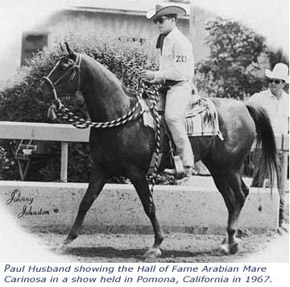
since. In 1964, when I was 14, I appeared in my first major U.S.
National Show, catch-riding a horse named Fadiah in the English
pleasure class for Sheila Varian."
Eventually,
the teenage Paul Husband was coached by the best California trainers of
that day. In addition to Jeff Wonnell, and his assistant trainer, Alan
Morgan, there was Kit Hall, Skip Carpenter, Roy Traylor, Toni Oppegard,
Pete Spears and Gary Brislawn, who eventually ended up in the racing
industry. As an English pleasure rider and exhibitor, Paul grew to
emulate top horseman Bruce Howard, a master of equitation form. In the
Western division he learned a great deal from the inimitable Sheila
Varian.
"You
know that famous picture of Sheila Varian riding _Bay-Abi with the rope
trailing out of the picture?" Paul says. "It was me on the other end of
that rope! At the time I was on the wrestling team in high school and
Sheila teased me into trying one of my holds on a calf. Well, I was
game, and eventually I did get the calf on the ground, but boy it sure
wasn't easy. The calf weighed 200 to 250 pounds or so, and I was
wrestling at a weight of 130. By the time we were through, both the
calf and I were wrecked — covered with cow dung and both our noses
bleeding. Then Margaret, who was working for Sheila at the time, came
over and threw a calf properly and promptly. It took her about 20
seconds. I was so impressed I yelled, ‘Good throw, Margaret!' A
photographer happened to be there at Varian's that day, and when she
wasn't laughing too hard to snap shots, she got some great pictures of
the bunch of us."
In
1966 Paul was Canadian National Champion Junior Arabian Horse
Exhibitor. He also won the Reserve Championship in English pleasure at
the Canadian National Show on Jurneeka. In those days, the actual
National Championship classes included only halter, but the show itself
had a number of classes and performance stakes. In her career, Jurneeka
went on to major National wins and _multi- U.S. National Reserve
Championships. She also became world famous as the dam of four-time
National Champion and leading Arabian sire Khemosabi. Paul Husband
graduated from high school, hung up his spurs for the time being, and
went off to college to study medicine and play football.
Paul
has also been innovative in creating new legal structures for use in
the horse business. He reworked the commonly recognized form of
Stallion Syndication into a more flexible arrangement that provided a
much more efficient management of stallions. It also allowed for a
different type of flexible investment in the realm of Stallion
Syndication, making the whole process much more feasible for involved
parties.
In
addition to being in demand as an attorney and advisor by major equine
groups (particularly Arabian and Thoroughbred owners and breeders),
Paul Husband has been a lecturer and speaker at Universities like
Pepperdine and Colorado State, as well as the California State Bar
Association and the American Horse Council, on tax laws as they relate
to horse breeders, trainers and exhibitors. There is little that
relates to horses and law that has escaped Paul. Recently he was
working with genuine enthusiasm on a presentation about the Right of
Publicity in Horses. "Horses and their owners do have a Right of
Publicity, in the names and likenesses of celebrity horses," Paul
explains with enthusiasm.
"It’s
easy to understand the publicity value of the use of "Lassie’s" or
"Trigger’s" names. The same thing applies to a *Bask or a Secretariat."
Eventually,
though, I had to settle down and get back on track toward a defensible
choice of careers.
"Fortunately
for me, a family friend had taken me along to a class at the Southern
Cal Law School one day when I was 12," Paul says. I joined a fraternity
that specialized in sports, partied a lot and played four years of
college football. In my senior year we were conference champions. I
studied the game of football harder than I ever studied at school and
was very successful as a linebacker. I was even named Best Defensive
Player. Eventually, though, I had to settle down and get back on track
toward a defensible choice of careers.
"Fortunately
for me, a family friend had taken me along to a class at the Southern
Cal Law School one day when I was 12," Paul says. "The subject was
‘Conflicts in Law,’ and I thought that I understood a great deal of the
lecture. I must have really enjoyed that class because I decided that
day that I might become a lawyer. Later, after I had taken
undergraduate classes in pre-med at college, I sat down and made the
decision to go into law instead of medicine. Nearly 30 years later, I
have never looked back, though there was a time when I considered
becoming a professional horse trainer. I actually did become an Arabian
horse judge, and before I retired from that arena, I judged horse shows
all over the U.S., in Canada as well as Australia. No matter where I’ve
gone and what I’ve accomplished in my work and my career, Arabian
horses have always been the not-so-secret focus of my life."
His
love for the Arabian horse gave Paul the incentive to become a
recognized expert in equine business practices and Arabian Horse
Valuation in various courts, including the United States Tax Court. His
expertise regarding tax conflicts specific to the horse industry has
made him a sought after attorney, speaker and teacher. He’s spoken and
lectured for the American Horse Council, the Colorado State University
and the California Polytechnic University in Pomona. Even the equine
publications got into the act and talked him into contributing articles
on the "Hobby Loss" issue as regarding horse operations, charitable
contributions of horses, partnerships and syndications, legal aspects
of transported semen, and how to land a profit in the horse business.
In short, as the legal voice of the Arabian horse industry, Paul
Husband has truly made his mark
"I
have a special affinity for horse owners," Paul says, "because I am a
horse owner. Every horse breeding and training operation has its own,
special story to tell. The key to presenting information about a horse
farm to a Tax Court is in the storytelling. First, you have to be able
to properly look into the background of a horse farm and understand
their particular situation. Each farm has its strengths and weaknesses.
Some have outstanding bloodstock; some have made their name in the show
ring or on the racetrack. Some farms show their mettle by being run
efficiently, and some do very well in the difficult arena of marketing
horses. I like to arrange the legal presentation so that the strengths
of the horse operation are immediately obvious to the court. Once,
after several appeals, I even got an IRS Appeals Officer to come out
and see a farm. At first glance the case had looked like a doctor was
trying to write off his daughter’s expensive hobby. But when the
Appeals Officer saw the operation, how efficiently it was run, and how
down-to-earth and business-like the farm functioned, he ruled in their
favor. Cases like that are infrequent, but what is important remains
constant — reading the situation at the farm and at the IRS accurately
… and portraying it in the right order, as well as the right light."
When
Paul Husband played football, he knew all of the plays by heart. As a
lawyer he works with the same efficiency. He never enters a courtroom
with a single plan. There’s always a contingency Plan B, and C and even
D. If necessary, he’s always ready to change his approach. When it
comes to expert advice on defending the IRS "Hobby Loss Challenges" or
legal information regarding Stallion Syndications, there’s no one more
knowledgeable.
"Hobby
Loss cases in the horse industry have become much more frequent of
late," Paul notes. "The IRS has been laying low for the past two or
three years, getting reorganized. But now, because of the poor state of
the economy, the country needs more money and, consequently, the number
of IRS audits has suddenly gone through the roof. It’s really not a
question of ‘if’ your horse farm will get audited, it’s more like
‘when.’ The IRS deals a ‘one-two punch’ using the ‘Passive Activity
Loss’ rules as a backup to the ‘Hobby Loss’ rules. The key to defending
against the second problem, the ‘Passive Activity Loss’ rules, revolves
around the 500-hour test. If a couple running a horse farm can prove
they have invested 500 hours or more of work per year (between the two
of them), they will generally be regarded as ‘active’ participants. By
the way, a spouse’s working hours count — the children’s do not. I wish
I’d known that when I was a kid cleaning stalls for my dad.
You also have to watch out for employment taxes. Many farm owners try
to pay their grooms as independent contractors. It doesn’t work.
Trainers, however, can be compensated either as an employee or as an
independent contractor, depending on the circumstances."
Is
it possible? Will horses soon be hiring their own press cadre and
signing multi-million dollar contracts with motion picture moguls? You
can bet your cinch strap that when it happens, unabashed Arabian horse
lover and equine attorney Paul Husband will be there helping them to
get their hoofprints on the bottom line.
Paul Husband has been a lawyer since 1977,
with his own firm since 1981. _His practice includes taxation law, tax
litigation, equine law and entertainment law. Paul’s current offices
are in Universal City, California.